


Artificial Turf vs Xeriscaping: Which Actually Saves More Water in Austin?
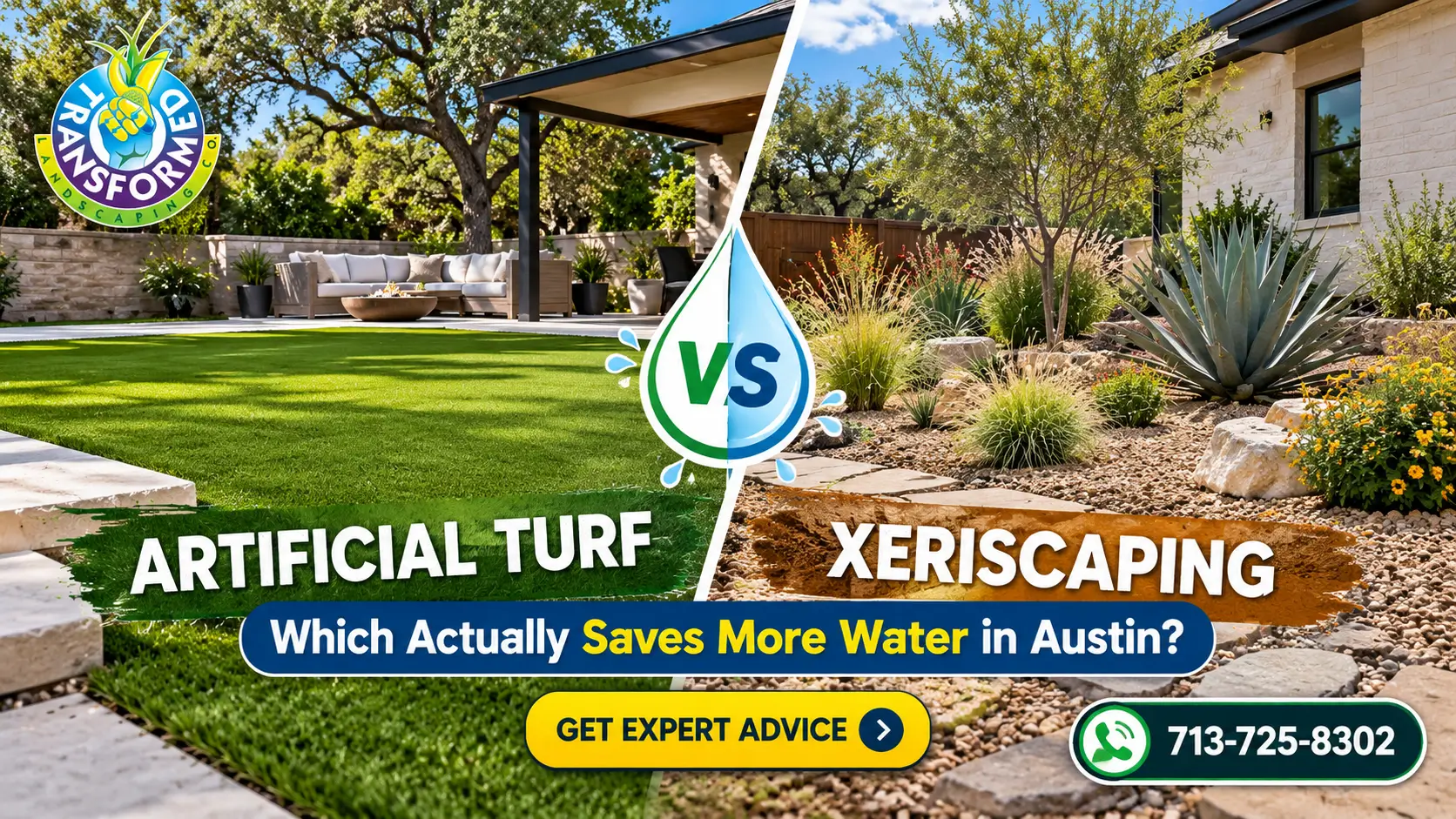
When Austin homeowners want to reduce lawn watering, two options often come up first: artificial turf and xeriscaping. Both can reduce dependence on a traditional irrigated lawn, but they solve the problem in very different ways.
So, in an artificial turf vs xeriscaping comparison, which saves more water?
If you measure only routine irrigation on the covered area, artificial turf generally requires less water because it does not need irrigation to stay green. Xeriscaping is still a living landscape, so plants need establishment watering and occasional supplemental irrigation.
But water use is only part of the decision. Heat, drainage, plant life, long-term maintenance, rebates, appearance, and how the yard feels during an Austin summer all matter.
For many homeowners looking for eco-friendly lawn alternatives in Austin, professionally designed xeriscaping offers a more balanced way to reduce water use while keeping the landscape alive.
Transformed Landscaping designs outdoor spaces that combine water-wise planting, irrigation, hardscape, and functional areas according to the needs of each property.
Artificial Turf vs Xeriscaping: The Quick Comparison
Both options can replace high-water lawn, but their strengths are different.
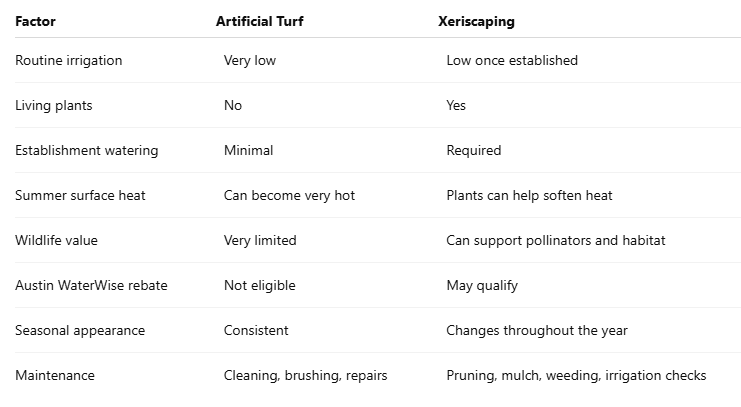
There is no universal winner for every homeowner. The better choice depends on what you expect the space to do.
How Much Water Does Xeriscaping Actually Use?
Xeriscaping is often misunderstood as landscaping that requires no water.
That is not the goal.
A xeriscape uses thoughtful plant selection, efficient irrigation, soil improvement, mulch, turf reduction, and appropriate hardscape to reduce unnecessary supplemental watering.
Austin Water states that mature native planting beds may need roughly one-half to three-quarters of an inch of water every other week, compared with traditional turf that may need about one inch each week during summer. It estimates that converting 500 square feet of turf to mature native planting could save up to 930 gallons per month, depending on the original watering habits and site.
New Xeriscapes Need More Water at First
Native and drought-tolerant plants are not instantly drought-proof.
During establishment, plants need consistent moisture while roots expand into surrounding soil. Water needs usually become lower after appropriate plants establish successfully.
This is why good xeriscaping design should include an establishment plan instead of simply removing grass and installing low-water plants.
Does Artificial Turf Use Any Water?
Artificial turf does not need irrigation for biological growth. That gives it an obvious advantage if the only question is how much water is needed to maintain a green-looking surface.
However, saying artificial turf uses absolutely no water can be misleading.
Homeowners may occasionally use water to:
- Rinse dust and debris
- Clean areas used by pets
- Wash spills or organic material
- Cool the surface before use during very hot weather
How often that happens depends on the household and installation.
Heat Changes the Austin Equation
Artificial surfaces can get considerably hotter than living vegetation when exposed to direct sunlight.
Research from Penn State has documented substantially higher surface temperatures on synthetic turf compared with natural grass, while City of Austin staff have also raised heat-related concerns about artificial turf.
That matters in Central Texas, especially when the space is meant for children, pets, lounging, or regular afternoon use.
Cooling Turf With Water Reduces Its Water Advantage
Some artificial turf users may rinse or cool the surface during extreme heat. Research shows water can temporarily reduce synthetic turf temperatures, but the cooling effect may be short-lived.
For a residential yard, shade and location should therefore be considered before selecting artificial turf simply because it appears maintenance-free.
A Low-Water Landscaping Comparison for Austin Homes
A useful low-water landscaping comparison should look beyond gallons alone.
Artificial Turf Works Best When You Need a Consistent Surface
Artificial turf may make sense in specific spaces where homeowners want a durable, green-looking surface without mowing or regular irrigation.
Examples could include:
- Small pet areas
- Narrow recreational spaces
- Areas where natural grass repeatedly fails
- Highly specific play or activity zones
That does not necessarily mean covering the entire yard with synthetic material.
Xeriscaping Works Best When You Want a Living Landscape
Xeriscaping is more suitable when the goal includes:
- Native flowers
- Shrubs and ornamental grasses
- Pollinator habitat
- Shade and plant structure
- Seasonal changes
- Better integration with existing trees
- Lower-water planting
- Natural Hill Country character
A Texas native planting plan can help homeowners create a landscape that feels intentional while responding to Austin's climate.
What Austin Water Says About Artificial Turf
One important difference is Austin Water's treatment of artificial turf within its WaterWise Landscape Rebate program.
Artificial turf is currently not eligible for the rebate.
The program is designed around converting qualifying turf grass into native plant beds using water-wise landscape practices. Austin Water currently offers residential WaterWise Landscape rebates of up to $3,000 for eligible projects.
Why That Matters for Homeowners
If you are already planning to remove a significant amount of lawn, rebate eligibility can affect the cost comparison.
A native landscape may require plants, mulch, soil preparation, and irrigation modifications, but a qualifying homeowner may be able to offset some project costs through the WaterWise program.
Homeowners should always confirm current eligibility and obtain required approval before starting work.
Which Option Is Better for Austin Heat?
This is where living landscapes have an important advantage.
Plants naturally exchange water with the atmosphere through transpiration. Vegetated areas can therefore feel very different from nonliving surfaces exposed to the same summer sun.
Artificial turf does not provide that natural cooling process.
Create Shade Instead of Covering Everything
A more comfortable Austin landscape can combine:
- Shade trees
- Native shrubs
- Ornamental grasses
- Mulched planting beds
- Shaded patios
- Limited functional lawn
- Stone or permeable walkways
The result can reduce water use without turning the entire yard into a hard or synthetic surface.
A professional landscape design can identify which parts of a property should remain planted and where constructed surfaces make sense.
What About Maintenance?
Neither artificial turf nor xeriscaping is maintenance-free.
That phrase should be treated cautiously with any landscape.
Artificial Turf Maintenance
Synthetic turf may require:
- Leaf and debris removal
- Brushing or grooming
- Pet waste cleaning
- Weed control around edges
- Occasional rinsing
- Repairs to seams or damaged sections
- Eventual replacement
Xeriscape Maintenance
A living water-wise landscape may require:
- Seasonal pruning
- Mulch replacement
- Weed control
- Irrigation checks
- Selective plant replacement
- Cutting back grasses and perennials
A well-designed xeriscape should generally become easier to manage as plants establish and fill their intended spaces.
Eco-Friendly Lawn Alternatives in Austin
Homeowners do not have to choose between a full traditional lawn and a completely synthetic yard.
Some of the most practical eco-friendly lawn alternatives in Austin involve combining multiple strategies.
Reduce Turf Instead of Replacing Everything With One Material
Consider converting unused lawn into:
- Native planting beds
- Mulched gardens
- Gravel or stepping-stone pathways
- Rain gardens
- Patio space
- Groundcover zones
- Shade gardens
Austin encourages native and adapted plants because appropriate species can require less watering, fertilizer, and chemical control.
Capture Rainwater Where It Falls
Water-wise design can also include areas that slow and absorb rainfall.
Austin describes rain gardens as planted depressions that collect runoff from roofs and hard surfaces, allowing water to soak into the soil while helping reduce erosion and runoff.
That is a benefit artificial turf alone cannot provide.
Don't Ignore Irrigation Design
Choosing drought-tolerant plants does not guarantee water efficiency if the irrigation system is poorly designed.
Planting beds, turf, trees, and containers may all need different watering schedules.
Professional irrigation services can help divide the property into zones and deliver water more appropriately.
Austin Water also recommends grouping plants with similar water requirements and using mulch to retain soil moisture.
Which Saves More Water in Austin?
The answer depends on what you are measuring.
If the comparison is strictly the amount of routine irrigation needed by the finished surface, artificial turf generally uses less because it does not need water to grow.
If the goal is creating a low-water landscape that also provides living plants, seasonal beauty, habitat, shade, soil benefits, and potential Austin Water rebate eligibility, xeriscaping offers a broader set of advantages.
For many properties, the best solution may not be an all-or-nothing choice.
A thoughtful landscape can use native planting, reduced lawn, functional hardscape, shaded outdoor living areas, and other low-water strategies exactly where they make sense.
Design a Yard Around More Than a Water Bill
The artificial turf vs xeriscaping decision should ultimately consider how you want the yard to look, feel, and function during a Texas summer.
Transformed Landscaping approaches water-conscious yards as complete outdoor environments rather than simple grass replacement projects.
Homeowners can review completed landscape transformations and see Transformed Landscaping's Google reviews and local business profile when researching a project.
Ready to replace water-hungry lawn with a more intentional landscape? Contact Transformed Landscaping to discuss your Austin yard, water goals, and design possibilities.
FAQs About Artificial Turf vs Xeriscaping
Does artificial turf save more water than xeriscaping?
For direct routine irrigation, artificial turf generally uses less water because it does not need irrigation to remain green. Xeriscaping still contains living plants that need some water, especially while establishing. Mature xeriscapes can nevertheless use substantially less supplemental water than traditional lawn.
Is artificial turf eligible for the Austin WaterWise rebate?
No. Austin Water currently states that artificial turf is not eligible for its WaterWise Landscape Rebate. Qualifying conversions focus on replacing existing turf with native plant beds.
Is xeriscaping completely maintenance-free?
No. Xeriscapes still require occasional pruning, weeding, irrigation checks, mulch replacement, and plant care. Good design can reduce unnecessary maintenance, but no living landscape is completely maintenance-free.
Does artificial turf get hot in Austin?
It can. Research has found synthetic turf surfaces can become substantially hotter than living grass in direct sunlight. Shade, turf type, location, and weather conditions influence the actual surface temperature.
What are good eco-friendly lawn alternatives in Austin?
Native plant beds, drought-tolerant gardens, reduced turf areas, rain gardens, mulch, permeable paths, functional hardscape, and efficient irrigation can all reduce dependence on traditional lawn.
Can xeriscaping still look modern?
Yes. Xeriscaping can use clean planting lines, repeated grasses, architectural plants, natural stone, modern pavers, restrained plant palettes, and defined outdoor spaces. Water-wise landscaping can be contemporary, formal, naturalistic, or Hill Country-inspired depending on the property.


