
.svg)

.svg)

Retaining Walls Austin TX: The Complete Homeowner's Guide to Slope, Drainage & Design
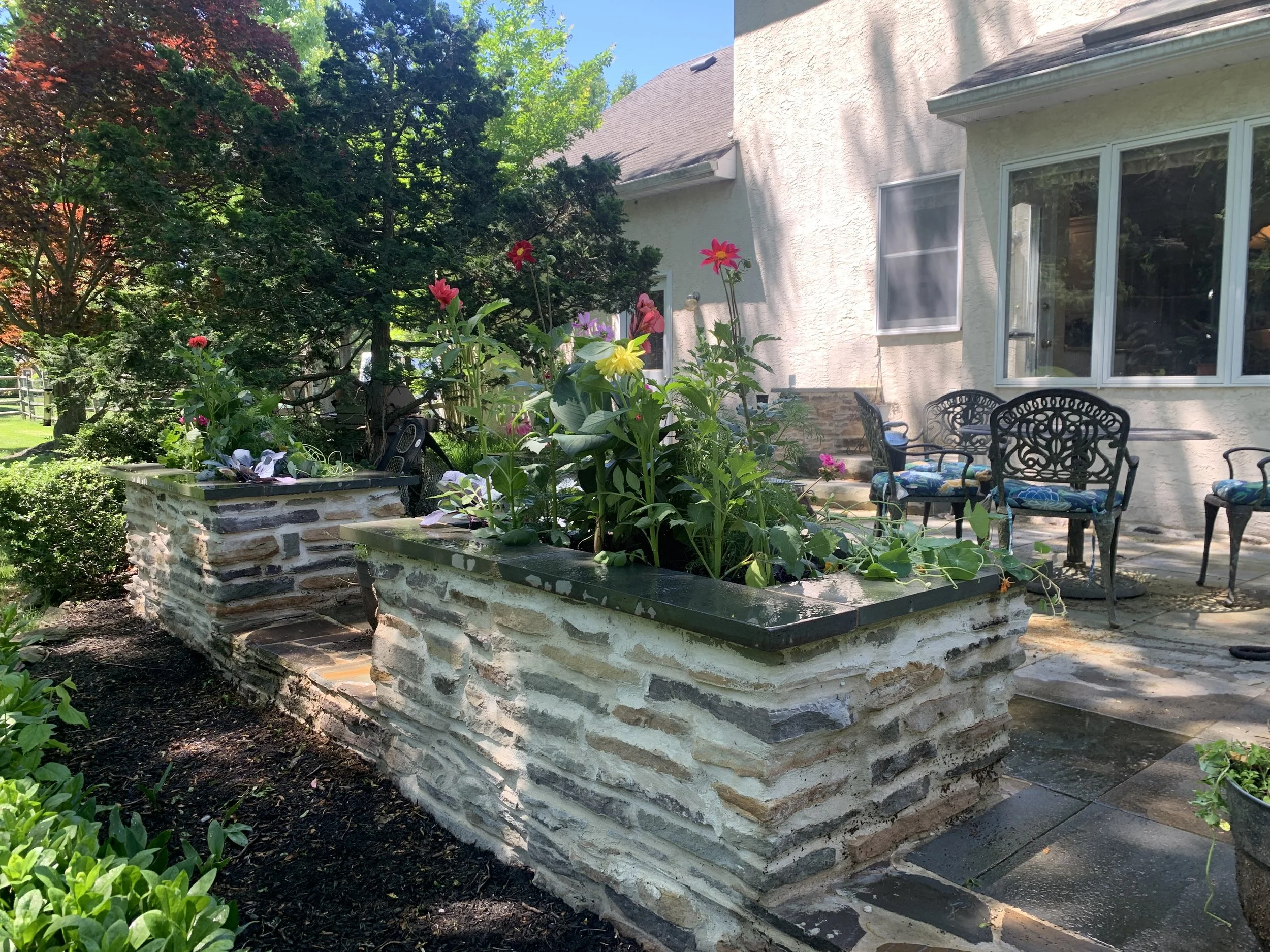
If your Austin property sits on a slope — and a significant portion of Central Texas properties do — you've probably already noticed what happens without proper soil management. Erosion carves channels through your yard after heavy rain. Soil creeps toward your foundation during wet seasons. Flat usable space is frustratingly scarce. And the natural beauty of your hillside lot feels more like a maintenance problem than an asset.
Retaining walls in Austin TX are the solution — and when designed and built correctly, they do far more than just hold back soil. A well-engineered retaining wall transforms a problematic slope into a series of beautiful, functional terraced spaces. It controls erosion permanently, manages drainage, protects your home's foundation from soil movement, and creates flat planting beds, lawn areas, and outdoor living zones out of terrain that was previously unusable.
In Austin's landscape — where sloped lots are common across South Austin, Westlake Hills, Barton Hills, and the surrounding Hill Country communities — retaining walls are one of the most impactful and most necessary investments a homeowner can make. This complete guide covers everything Austin homeowners need to know about retaining walls — types, materials, drainage engineering, permit requirements, costs, and what to look for in a professional retaining wall contractor in Austin TX.
Why Retaining Walls Matter More in Austin TX Than Most Places
Austin's terrain, soil, and rainfall patterns create a perfect storm of conditions that make retaining walls not just aesthetically desirable but structurally necessary on many properties.
Sloped terrain is everywhere. Austin sits at the edge of the Edwards Plateau — the limestone highland that gives the Texas Hill Country its dramatic topography. Neighborhoods throughout the city — Westlake Hills, Barton Hills, South Austin, Tarrytown, Travis Heights, and dozens of communities in the surrounding Hill Country — feature lots with meaningful elevation changes that demand engineered solutions for soil stability and drainage.
Austin's soil is challenging. The combination of expansive clay and rocky limestone that characterizes much of Austin's subsurface is particularly prone to movement. Clay soil expands when wet and contracts when dry — creating a constantly shifting ground condition that accelerates erosion on slopes and puts lateral pressure on any retaining wall structure. A properly engineered Austin TX retaining wall accounts for this soil behavior in its design, drainage, and material selection.
Austin's rainfall is intense when it comes. While Austin experiences extended drought periods, the rainfall that does arrive often comes in concentrated, intense events — Central Texas flash flood events that dump several inches of rain in a matter of hours. Without proper retaining walls and drainage management, these events cause rapid, severe erosion on sloped Austin properties and can send significant volumes of soil moving toward foundations and neighboring properties.
Foundation protection is critical. Soil movement on sloped Austin properties — whether from erosion or expansive clay shifting — is one of the leading contributors to foundation problems. A properly designed system of retaining walls that controls soil movement and directs drainage away from the home's foundation perimeter is one of the most valuable protective investments an Austin homeowner can make.
Types of Retaining Walls for Austin TX Properties
Different retaining wall types serve different purposes and suit different aesthetic preferences, budgets, and engineering requirements. Here's a breakdown of the most common retaining wall types used in Austin TX landscaping.
Limestone Retaining Walls
Limestone is the gold standard of retaining wall construction in Austin TX — and for deeply rooted reasons. Austin sits on limestone bedrock. The Hill Country is defined by limestone outcroppings. Using locally sourced limestone for retaining walls creates structures that feel authentically connected to the Central Texas landscape — as if the wall has always been there.
Beyond aesthetics, limestone is exceptionally durable, handles Austin's temperature extremes and moisture cycles without degrading, and develops a beautiful natural patina over time that improves with age. Natural limestone retaining walls can be built as dry-stacked structures — without mortar — which allows natural drainage through the wall face and creates perfect planting pockets for cascading native plants. They can also be mortar-set for maximum structural integrity on taller, more engineered applications.
For Austin TX homeowners who want a retaining wall that looks like it belongs in the landscape rather than being imposed upon it, natural limestone is almost always the first recommendation.
Concrete Block Retaining Walls
Engineered concrete block systems — such as Allan Block, Versa-Lok, and similar interlocking concrete masonry systems — are one of the most widely used retaining wall options in Austin TX for their combination of structural performance, design flexibility, and cost-effectiveness.
These systems use precisely manufactured concrete blocks that interlock geometrically to create a stable, cohesive wall structure without mortar. They're engineered for specific loading conditions and can be built to significant heights with appropriate geogrid reinforcement — making them suitable for the more demanding slope retention challenges found on Austin's hillside properties.
Concrete block retaining walls are available in a range of textures and colors — including options that convincingly mimic natural stone — and can be combined with natural stone cap courses and veneer facing to achieve a more naturalistic appearance. For retaining wall projects in Austin TX where structural performance and cost management are the primary considerations, quality concrete block systems deliver reliable results.
Poured Concrete Retaining Walls
For the highest structural requirements — tall retaining walls, heavy loading conditions, or situations where minimal footprint is critical — poured concrete retaining walls provide maximum strength in the least horizontal space. Poured concrete walls are engineered as monolithic structures with continuous steel reinforcement and deep footings designed specifically for Austin's soil conditions.
Poured concrete retaining walls are typically used in commercial applications and high-demand residential situations in Austin — steep driveway cuts, major grade changes adjacent to structures, and situations where the wall must handle significant surcharge loading from vehicles, structures, or large equipment. They're often finished with stone veneer, plaster, or board-formed texture for aesthetic appeal.
Gabion Retaining Walls
Gabion retaining walls — wire mesh cages filled with rock — are an increasingly popular choice in Austin TX for their naturalistic aesthetic, excellent drainage performance, and structural versatility. The wire cages create a gravity-based wall structure that's flexible enough to handle Austin's soil movement without cracking, and the open rock-filled face allows excellent water drainage that reduces hydrostatic pressure behind the wall.
Filled with locally sourced limestone or river rock, gabion retaining walls create a beautifully textured, organic-feeling structure that blends naturally into Austin's Hill Country landscape character. They're an excellent choice for larger-scale slope management on rural and semi-rural Austin properties.
Timber Retaining Walls
Pressure-treated timber retaining walls — and their modern composite equivalent — are suitable for smaller-scale retention applications in Austin TX: low garden bed borders, gentle slope management, and decorative landscape edging. They're among the more affordable retaining wall options and can be installed relatively quickly.
The primary limitation of timber retaining walls in Austin TX is longevity. Even quality pressure-treated lumber degrades more quickly in Austin's heat, UV exposure, and soil moisture conditions than masonry alternatives — typically requiring replacement within 10 to 15 years. For any retaining wall application where long-term structural performance matters, masonry is the more durable investment.
The Critical Role of Drainage in Austin TX Retaining Walls
Here's the most important thing most Austin homeowners don't know about retaining walls: the wall itself is only half of the engineering. The drainage system behind and beneath the wall is equally critical — and it's where most failed retaining walls in Austin go wrong.
Water is a retaining wall's greatest enemy. When rainfall saturates the soil behind a retaining wall, that wet soil becomes dramatically heavier — and the hydrostatic pressure it exerts against the wall increases exponentially. A retaining wall built without adequate drainage to relieve this pressure will eventually fail — cracks, bulging, or complete collapse are the typical outcomes.
Professional retaining wall construction in Austin TX always includes a comprehensive drainage design that typically incorporates the following elements:
Gravel Drainage Backfill — The area immediately behind the retaining wall is filled with crushed gravel rather than native soil. Gravel drains freely, preventing water accumulation and dramatically reducing hydrostatic pressure against the wall face.
Perforated Drain Pipe — A perforated drain pipe installed at the base of the retaining wall collects water that drains through the gravel backfill and directs it to a safe outlet away from the wall and the home's foundation.
Weep Holes — In mortared retaining walls, weep holes at regular intervals along the base of the wall allow water that does accumulate behind the wall to escape through the face rather than building up to failure pressure.
Surface Water Diversion — Swales, drains, and grading above the retaining wall divert surface runoff away from the wall before it has a chance to saturate the retained soil.
A professional retaining wall contractor in Austin TX designs the drainage system as an integral part of the wall project — not as an afterthought. Skipping or shortcutting the drainage design is the single most common reason retaining walls fail in Austin's climate.
Retaining Walls as Design Features in Austin TX Landscapes
The most sophisticated Austin TX landscape designs treat retaining walls not as purely utilitarian structures but as prominent design features that contribute meaningfully to the beauty and character of the outdoor space. Here are the most compelling design approaches.
Terraced Garden Systems — Multiple retaining walls at different elevations create a series of terraced planting beds that transform a steep Austin slope into a layered, lush garden landscape. Each terrace becomes an opportunity for a different planting palette — native shrubs, flowering perennials, ornamental grasses, and ground covers — that cascades beautifully down the slope. This approach is particularly stunning on South Austin and Westlake Hills properties with dramatic elevation changes.
Seating Wall Integration — A retaining wall built to a height of 18 to 24 inches with a finished cap course becomes a natural seating wall around a patio or fire pit area. This dual-function approach — retaining soil above while providing informal seating at patio level — is one of the most space-efficient and visually elegant retaining wall applications in Austin TX outdoor living design.
Planting Pocket Design — Dry-stacked limestone retaining walls can be designed with intentional gaps and pockets between courses where trailing native plants — Trailing Lantana, Spreading Rosemary, Autumn Sage, and ornamental grasses — can be planted to cascade over the face of the wall. Over time, these plant-integrated retaining walls become living features that soften the stone with cascading color and texture.
Water Feature Integration — A retaining wall and waterfall are natural companions on sloped Austin properties. The grade change that necessitates a retaining wall creates the perfect opportunity to incorporate a pondless waterfall or stream that flows from the upper terrace down to the lower level — turning a drainage solution into one of the most beautiful features on the property.
Limestone Outcropping Aesthetic — On Austin properties where the design goal is a naturalistic, Hill Country-inspired landscape, retaining walls built from locally sourced limestone boulders — positioned to mimic natural rock outcroppings — create the impression that the landscape is organically connected to the Central Texas geology beneath it. This approach requires skilled stonework but delivers stunning, completely authentic-looking results.
Retaining Wall Permits in Austin TX
Permit requirements for retaining walls in Austin TX depend on the height, location, and structural design of the wall. Here's what Austin homeowners need to know.
In the City of Austin, retaining walls over 4 feet in height measured from the bottom of the footing typically require a building permit and engineering review. Retaining walls in floodplain areas require permits regardless of height. Retaining walls adjacent to property lines, in protected tree zones, or in areas with specific drainage requirements may have additional review requirements.
Many municipalities surrounding Austin — Westlake Hills, Bee Cave, Lakeway, Cedar Park, and Dripping Springs — have their own specific retaining wall ordinances that may differ from City of Austin requirements. If your property is in one of these jurisdictions, your retaining wall contractor should verify local requirements before design is finalized.
Transformed Landscaping Co. handles all permit research, engineering documentation, and City of Austin or municipal permit applications for retaining wall projects — ensuring your wall is designed, engineered, and built to full compliance from the start.
Retaining Wall Costs in Austin TX — Realistic 2026 Pricing
Retaining wall costs in Austin TX vary significantly based on wall type, height, length, drainage requirements, and site complexity. Here's a realistic cost framework for 2026.
Natural limestone dry-stack retaining walls: $40 to $75 per square foot of wall face installed, depending on stone size and wall height. Mortar-set limestone walls with engineered drainage systems run $55 to $90+ per square foot.
Engineered concrete block retaining walls: $25 to $50 per square foot of wall face installed for standard heights with basic drainage. Taller walls requiring geogrid reinforcement run $40 to $70+ per square foot.
Poured concrete retaining walls: $60 to $100+ per square foot of wall face installed for engineered residential applications.
Gabion retaining walls: $30 to $60 per square foot of wall face installed depending on wire cage specifications and fill rock material.
For a typical Austin TX retaining wall project — 50 linear feet at 3 to 4 feet tall in natural limestone with drainage — expect a total installed cost of $12,000 to $25,000 depending on site conditions and material choices. Larger, more complex retaining wall systems on steeply sloped Hill Country properties can run $30,000 to $75,000 or more.
The most important cost consideration for retaining walls in Austin TX is that inadequate drainage design will always result in wall failure — and a failed retaining wall costs far more to repair or replace than it would have cost to build correctly the first time. Invest in proper drainage from the start.
5 Tips for Getting the Best Results From Your Austin TX Retaining Wall Project
1. Engineer for Drainage First, Aesthetics Second
Every design decision about your retaining wall in Austin TX should follow the drainage solution — not precede it. Understand your property's drainage patterns, where water accumulates and flows during heavy rain events, and what drainage infrastructure is needed behind your wall before finalizing material choices and design details.
2. Choose Materials That Age Well in Austin's Climate
Locally sourced limestone improves visually over time in Austin's climate, developing a beautiful natural patina that deepens with age. Engineered concrete block products hold their appearance consistently. Both outperform wood and other organic materials dramatically for long-term retaining wall performance in Central Texas.
3. Plan Your Retaining Wall as Part of the Complete Landscape
The most beautiful and functional Austin TX retaining wall projects are those designed as integral elements of a complete landscape — where the wall, the planting above and below it, the patio or outdoor living space at its base, and the drainage infrastructure all work together as one cohesive system.
4. Don't Underestimate the Height
Austin homeowners frequently underestimate how tall their retaining walls need to be to properly manage their slope. A wall that's 6 inches too short means soil slumps over the top during heavy rain, undoing the purpose of the installation. Have a professional assess the full grade change and design the wall height for complete, permanent retention.
5. Protect Existing Trees During Construction
Austin's mature Live Oaks and Cedar Elms are irreplaceable landscape assets — and retaining wall construction near their root zones requires careful planning to avoid damaging root systems. A skilled retaining wall contractor in Austin TX designs wall routing and footing methods that protect existing trees throughout the construction process.
Transformed Landscaping Co. — Retaining Wall Construction in Austin TX
At Transformed Landscaping Co., retaining walls are one of our core hardscaping specialties. We design and build retaining walls in Austin TX using locally sourced limestone, engineered concrete block, and custom stone systems — always with drainage infrastructure engineered specifically for your site's conditions.
Every retaining wall project begins with a free site evaluation and thorough drainage assessment, moves through a custom design process with 3D visualization so you see your finished landscape before construction begins, and is built by experienced hardscape craftsmen who understand Austin's soil, terrain, and climate demands.
We handle permit research, engineering documentation, and HOA approval coordination — and we integrate every retaining wall project into a complete landscape design that makes your Austin property more beautiful, more functional, and more valuable.
Protect Your Property and Elevate Your Landscape With the Right Retaining Wall
A professionally designed and built retaining wall in Austin TX protects your foundation, controls erosion, manages drainage, and creates usable outdoor space out of terrain that was previously working against you. When it's designed beautifully — using natural limestone, thoughtful planting integration, and intentional connection to the rest of your outdoor space — it becomes one of the most striking features on your property.


.svg)